
This message was shared with Students, Faculty & Staff on Friday, June 12th, 2020.
|
|
Dear UHS community:
I am writing these reflections on June 12, Loving Day, which, being an interracial couple, my partner and I celebrate instead of Valentine’s Day in February. Short version: this day is the anniversary of the 1967 United States Supreme Court decision Loving v. Virginia, which struck down all anti-miscegenation laws remaining in sixteen U.S. states.
This year’s Loving Day feels different to me—it feels like more of an observation of a holiday than a celebration. And it’s not because my partner and I can’t go out to a favorite restaurant as usual due to Covid-19 the way couples go out for a nice meal together on Valentine’s Day. Rather, it’s because the context surrounding the day is different this year—personally and socio-politically.
Personally: I’ve been sheltering in place, barely going outside, feeling privileged that I have a comfortable home in which to shelter, and figuring out how to “keep my foot on the gas” without going to protests.
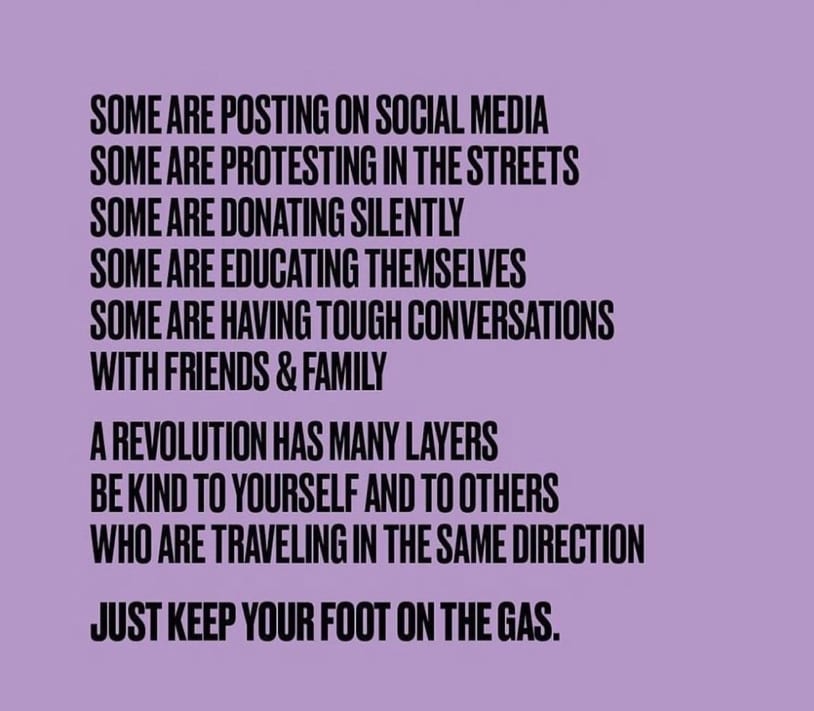
Normally, I’d be out in the streets, putting all the how to be safe during a protest knowledge I’ve shared with others into practice myself despite my family’s worries about my health and safety. But not this time. This time (and it’s sad it’s “this time” because there will sadly be a next time), as some of you know, I am pregnant with a mixed-race child, who will likely appear to the world as Black. Everything feels different now. It didn’t really sink in until a friend had to reframe things for me and relieve me of my ambivalence around staying home: “You are protecting a Black life by sheltering in place.”
More context: a week after Loving Day is Juneteenth — the day that Union Army Maj. Gen. Gordon Granger rode into Galveston, Texas, and told slaves of their emancipation. For my growing family, Loving Day is to Valentine’s Day as Juneteenth is to the 4th of July. Our family will be celebrating Juneteenth the way other families gather with friends and family on July 4—“America’s first Independence Day, some ‘four score and seven years’ before President Lincoln issued the Emancipation Proclamation,” as Henry Louis Gates, Jr. points out.
Socio-politically: We are amidst two global pandemics: racism/anti-Blackness and Covid-19 which has disproportionately impacted Black, Indigenous, and People of Color (BIPOC) communities. In the context of these pandemics and the Black Lives Matter protests across the country as well as the world, Donald Trump has announced that he will be holding a rally in Tulsa, Oklahoma on June 19, 2020: the 155th anniversary of the day that commemorates the end of slavery in the United States. And the significance of the location Donald Trump’s campaign chose? It is the location of the 1921 Tulsa Race Massacre.
Coincidence? There are varying opinions on this. On the one hand, Donald Trump has said the day for the rally was not chosen on purpose by his campaign. On the other hand, California Sen. Kamala Harris and Tulsa civic officials have called the choice “a slap in the face,” and asked that Donald Trump at least change the date of his rally to Saturday, June 20. Multiple news sources warn that there is unrest brewing, and this rally will be “a disaster.”
And that brings me to WHY I am writing these reflections, and doing so with two hats on:
- I am writing as Tilda, the person—pregnant with a mixed-race baby, thinking about the world into which I will be bringing a new human being, who will most likely present Black, because that is my current positionality in this sociopolitical context.
- I am also writing this letter as Tilda, the Director of Equity and Community at UHS, to provide some context and information about why our Black community members are (and let’s be honest: have been) fatigued, emotionally and physically drained, and angry—so that they don’t feel like they have to, once again, step up to explain themselves or educate the rest of us.
So let’s educate ourselves.
- Please take some time in the next week to click through some of the links in this letter as well as the additional resources at the bottom. Read, listen, watch, reflect.
- Then, come to your own conclusions about whether or not you think Donald Trump’s campaign selected the date and the location of the rally intentionally.
- Assume, for instance, that Donald Trump’s team did not, as they have explained, intend to send a message with this choice of date and location. UHS students could tell you, from what they’ve learned in Human Development classes as well as from attending identity club meetings and affinity spaces that there’s a difference between intent and impact, and that good intentions do not erase harmful impact. What do you think should happen? Should Donald Trump change his rally date? The rally location?
- Assume, for instance, that Donald Trump’s team did not, as they have explained, intend to send a message with this choice of date and location. UHS students could tell you, from what they’ve learned in Human Development classes as well as from attending identity club meetings and affinity spaces that there’s a difference between intent and impact, and that good intentions do not erase harmful impact. What do you think should happen? Should Donald Trump change his rally date? The rally location?
- And after you have come to your own conclusions, ask yourself what I you can do to “keep your foot on the gas.”
Whatever you do, wherever you start from, I hope you sustain your efforts. Be a threat to any inequity that exists in your communities—even when these topics are no longer in the headlines.
More resources:
- The Woman Who Kept Juneteenth Alive in San Francisco
- Not Just Tulsa: Five Other Race Massacres That Devastated Black America
- Video: The massacre of Tulsa's "Black Wall Street" (9:12)
- The Devastation of Black Wall Street
- TV show: Watchmen (2019); available on HBO
- Film: Loving (2016); available to rent on Netflix, Amazon Prime.
- Slideshow on Juneteenth that a colleague at another school, Uyola Jade, created for her students. Feel free to use/adapt.
- Teaching Juneteenth
- Some virtual Juneteenth events:
- June 18 and June 19 Oakland Cemetery Events
- June 18, Juneteenth Virtual Music Festival
- June 19, MOAD Juneteenth Presentation | Harlem of the West: The San Francisco Fillmore Jazz Era
- June 19, The Theater Justice Project: theatre communities around the country will provide their response to the current moment – the civil uprising that has come as a reaction to the murders of George Floyd, Breonna Taylor, Ahmaud Arbery and countless others before them – with simultaneous free readings of Vincent Terrell Durham’s bold new play, Polar Bears, Black Boys & Prairie Fringed Orchids.
- June 20, Elegba Folklore Society livestream on Facebook (from Richmond, VA)
- June 21, Muslims for Progressive Values meet-up
- …AND many more from all over the country! (Just google “Virtual Juneteenth event,” and you’ll see!)
Thank you for reading.
With care,
Tilda Kapuya
[she/her/hers]
Director of Equity and Community
|


